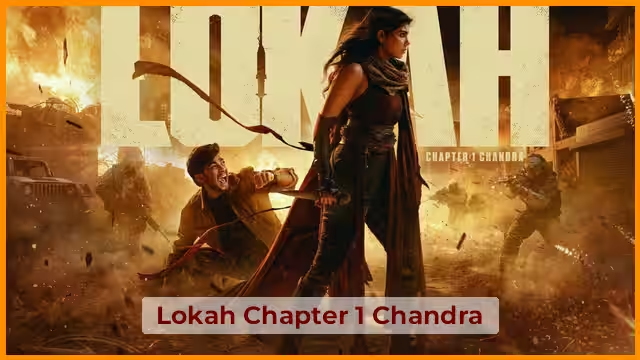
Lokah Chapter 1: Chandra Review – A Superheroine Who Redefines Telugu Cinema
1. Movie Summary & Story
Lokah Chapter 1: Chandra drops the audience into a sprawling, myth‑infused metropolis where ancient folklore collides with high‑tech heroics. The narrative follows Chandra (Kalyani Priyadarshan), a seemingly ordinary college student who discovers she is the reincarnation of a celestial guardian foretold in regional legends. When a shadowy syndicate, led by the power‑hungry warlord Vikram Reddy, begins siphoning the city’s life‑force to fuel a weapon capable of erasing entire districts, Chandra is thrust onto a path that forces her to master her dormant powers—luminescent energy manipulation, flight, and a unique “lunar shield” that can deflect both physical and metaphysical attacks.
The stakes are layered: on a personal level, Chandra must reconcile her modern identity with the weight of a millennia‑old oath; on a societal level, the film pits the collective spirit of the city against a corporate‑military complex that treats human lives as expendable resources. The first half is a kinetic world‑building exercise, introducing the audience to the Lokah Universe—a blend of neon‑lit skylines, ancient temples, and secret underground labs. The interval point arrives when Chandra, after a harrowing confrontation in the ruins of an old fort, unlocks the “Chandra Pulse,” a spectacular visual set‑piece that not only turns the tide in the battle but also serves as the emotional climax of her internal awakening.
The second half, while slower in tempo, delves deeper into the mythic underpinnings of Chandra’s lineage. It reveals the true nature of the villain’s plan: to create a perpetual eclipse that would grant him god‑like control over time itself. The final showdown is a high‑octane blend of martial choreography, CGI‑enhanced energy battles, and a poignant sacrifice that sets the stage for future chapters. Though the villain’s motivations feel a touch undercooked, the film’s commitment to a larger, interconnected universe makes the slower moments feel purposeful rather than filler.
2. Cast & Crew
| Role | Name |
|---|---|
| Director | Dominic Arun |
| Producer | Dulquer Salmaan |
| Lead Actress (Chandra) | Kalyani Priyadarshan |
| Main Antagonist (Vikram Reddy) | Prakash Raj |
| Supporting Actress (Maya) | Nivetha Thomas |
| Cinematographer | R. Rathnavelu |
| Music Composer / BGM | Mickey J Meyer |
| Editor | Prawin P. Kumar |
| Production Designer | S. Vijayalakshmi |
(Only the principal contributors are listed; the film boasts a sizable ensemble of talented technicians and cameo appearances.)
3. Technical Aspects
Cinematography – R. Rathnavelu’s lens work is the film’s visual backbone. He juxtaposes the gritty, rain‑slick streets of Hyderabad with hyper‑stylized, CGI‑heavy dreamscapes that represent Chandra’s inner world. The use of low‑key lighting during the villain’s scheming scenes creates a palpable sense of dread, while the “lunar pulse” sequence employs sweeping crane shots and a high‑frame‑rate slow‑motion that makes the energy bursts feel tangible. The colour palette shifts from cool blues and silvers in the hero’s moments to aggressive reds and oranges when the antagonist’s technology dominates, reinforcing the thematic clash between nature and artificiality.
Music & Background Score – Mickey J Meyer delivers a soundtrack that oscillates between orchestral grandeur and contemporary electronic beats. The main theme, a haunting sitar motif layered over pulsating synths, recurs whenever Chandra taps into her ancestral power, effectively tying the film’s modern aesthetic to its cultural roots. Action set‑pieces are underscored with throbbing bass drops that heighten adrenaline, while quieter, emotional beats are supported by minimalist piano passages that let Kalyani’s performance breathe. The BGM never overwhelms the dialogue; instead, it acts as an invisible narrator, guiding the audience through the film’s tonal shifts.
Pacing & Editing – Editor Prawin P. Kumar structures the film around a classic three‑act rhythm, but the first act stretches a little long, indulging in elaborate world‑building. This is mitigated by the interval climax, which re‑energises the audience. The second act’s slower tempo allows character introspection, though some viewers may perceive it as a dip in momentum. The final act regains a brisk pace, thanks to tight cross‑cutting between the hero’s preparation and the villain’s countdown. Overall, the editing maintains narrative clarity despite the heavy reliance on visual effects.
4. Performances & Characters
Kalyani Priyadarshan (Chandra) – Kalyani carries the film on her shoulders. Her transformation from a hesitant student to a confident guardian feels earned, thanks to nuanced facial work and a physicality that blends martial arts with graceful, almost balletic movements during the energy‑combat scenes. She injects humor in the early “college” moments, making the later gravitas all the more striking.
Prakash Raj (Vikram Reddy) – The antagonist is charismatic but suffers from a thin backstory. Raj delivers a menacing presence, especially in the boardroom sequences where his ambition is laid bare, yet the script does not fully explore his motivations beyond power lust.
Nivetha Thomas (Maya) – As Chandra’s best friend and tech‑savvy ally, Maya provides essential exposition and comic relief. Thomas shines in the scenes where she hacks the villain’s network, showcasing a blend of intellect and loyalty.
Supporting Cast – The ensemble, including veteran actors like Rao Ramesh as the wise monk who mentors Chandra, adds depth to the mythic layer. Their brief appearances are enough to hint at a larger mythology without crowding the central narrative.
5. Box Office & Collection
Lokah Chapter 1: Chandra opened to a strong weekend in the Telugu belt, grossing approximately ₹45 crore across 2,000 screens, according to early trade reports. The film’s budget, estimated at ₹30 crore, suggests a healthy recovery within the first five days, with ancillary revenue expected from satellite and OTT rights. Social media buzz and the presence of Dulquer Salmaan as producer have amplified word‑of‑mouth, positioning the film as a potential franchise starter.
6. What Works & What Doesn’t
Pros
- Kalyani Priyadarshan’s compelling lead performance.
- Spectacular visual effects and world‑building that set a new benchmark for Indian superhero cinema.
- Music by Mickey J Meyer that seamlessly blends traditional motifs with modern beats.
- Strong thematic core: the clash between ancient heritage and unchecked technological ambition.
Cons
- The villain’s arc feels underdeveloped, reducing the emotional impact of the final showdown.
- Second‑half pacing drags for viewers expecting non‑stop action.
- Some CGI sequences, while ambitious, reveal occasional texture inconsistencies.
7. My Rating & Final Verdict
Rating: ★★★★☆ (4 out of 5)
Lokah Chapter 1: Chandra is a landmark moment for Telugu cinema, daring to place a female superhero at the centre of a high‑budget spectacle. While it isn’t flawless—particularly in its antagonistic depth and mid‑film tempo—the film’s visual ambition, resonant music, and Kalyani’s magnetic performance make it a must‑watch theatrical experience. It not only entertains but also opens the door for a home‑grown superhero universe that can stand shoulder‑to‑shoulder with global franchises.
Verdict: If you enjoy superhero sagas that honour cultural roots while delivering modern spectacle, book your tickets now. The film’s first half alone justifies the price, and the promise of future chapters ensures that the journey has only just begun.