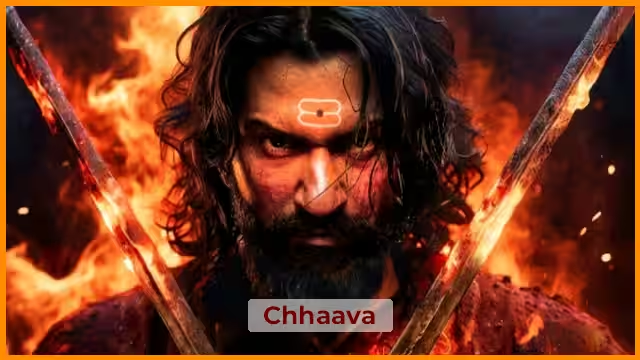
Chhaava Review – A Grand Tale of Valor That Echoes Through Time
Movie Summary & Story
Set against the turbulent backdrop of 18th‑century India, Chhaava follows the rise of a legendary warrior‑king whose quest for unity and freedom becomes a crucible of blood, love, and political intrigue. The narrative opens in a fragmented kingdom where regional chieftains vie for supremacy, and a young Vicky (Vicky Kaushal) is thrust into the role of reluctant leader after his father’s untimely death.
What drives the story forward is not merely the spectacle of massive battlefields but the emotional stakes that bind the characters: a forbidden romance with Rashmika’s fierce princess‑turned‑rebel, the looming betrayal by a trusted mentor (Akshaye Khanna), and the ever‑present pressure of a people yearning for a just ruler. The film balances large‑scale war choreography with intimate moments—quiet conversations by a campfire, a tender duet that underscores the cost of duty, and the internal conflict of a hero torn between personal desire and collective responsibility.
Thematically, Chhaava explores patriotism without jingoism, the burden of legacy, and the idea that true leadership is forged in sacrifice. By interweaving personal drama with the grand sweep of history, the screenplay keeps the audience invested in both the macro‑political outcomes and the micro‑emotional journeys of its protagonists.
Cast & Crew Table
| Role | Name |
|---|---|
| Director | Laxman Utekar |
| Producer | Dinesh Vijan (Maddock Films) |
| Lead Actor (Protagonist) | Vicky Kaushal |
| Lead Actress (Female Lead) | Rashmika Mandanna |
| Supporting Actor (Mentor) | Akshaye Khanna |
| Cinematographer | Saurabh Goswami |
| Editor | Manish Pradhan |
| Music Composer | A. R. Rahman |
| Distribution (India) | Pen Marudhar |
| Distribution (International) | Yash Raj Films |
| Production House | Maddock Films |
Technical Aspects
Cinematography – Saurabh Goswami treats the screen like a living tapestry. The sweeping drone shots of the Himalayan foothills and the claustrophobic close‑ups inside war tents create a visual contrast that mirrors the film’s thematic duality—vast ambition versus personal turmoil. The colour palette shifts from earthy ochres during battle sequences to cooler blues in moments of introspection, reinforcing the emotional tone of each scene.
Music & Background Score – A. R. Rahman’s soundtrack is the film’s beating heart. The rousing anthem “Veer Senani” lifts the morale of the troops while the melancholic “Jeevan Ki Jyoti” underscores the love story, using a blend of traditional ragas and modern orchestration. The battle‑driven track “Rannbhoomi” employs heavy percussion and brass to amplify the intensity of combat, whereas “Rajyabhishek” uses a choir to evoke the gravitas of coronation. Rahman’s background score never overpowers the dialogue; instead, it subtly amplifies tension, allowing the audience to feel the stakes without being distracted.
Pacing & Editing – At 161 minutes, the film could have succumbed to sluggishness, but Manish Pradhan’s crisp editing maintains momentum. The first act establishes characters efficiently, the second act escalates with a series of well‑timed skirmishes, and the climax builds to a crescendo without unnecessary filler. Transitional sequences—such as the montage of army recruitment—are paced to keep the narrative drive alive while giving viewers breathing space to absorb emotional beats.
Performances & Characters
Vicky Kaushal (Protagonist) – Kaushal delivers a performance that is both physically imposing and emotionally nuanced. His transformation from a grieving son to a charismatic commander feels earned, thanks to disciplined body language, measured dialogue delivery, and moments of vulnerability that prevent the hero from becoming a caricature.
Rashmika Mandanna (Princess‑Rebel) – Mandanna shines as a strong‑willed woman who challenges patriarchal expectations. Her chemistry with Kaushal is palpable, and her solo “Jeevan Ki Jyoti” showcases her ability to convey longing through subtle facial expressions. She brings depth to a character that could have been relegated to a love‑interest trope.
Akshaye Khanna (Mentor/Antagonist) – Khanna’s portrayal of the conflicted mentor-turned‑traitor adds a layer of moral ambiguity. His measured cadence and piercing gaze make his eventual betrayal all the more shocking, turning him into a memorable antagonist rather than a one‑dimensional villain.
Supporting actors—though not listed in detail—provide solid groundwork, especially in the battlefield scenes where ensemble coordination is essential for authenticity.
Box Office & Collection
- Budget: Estimated ₹200–250 crore, a figure that reflects the massive set constructions, VFX‑intensive battle sequences, and period‑accurate costumes.
- Opening Day Projection: ₹40–50 crore, positioning it among the strongest launches for a historical drama.
- First Weekend Projection: ₹120–150 crore, buoyed by positive word‑of‑mouth and strong pre‑release buzz.
- Lifetime Projection: If momentum sustains, the film could breach the ₹500 crore worldwide mark, potentially ranking it as one of the highest‑grossing Indian releases of 2025.
- International Distribution: Handled by Yash Raj Films, ensuring a wide release across key overseas markets and contributing to the projected global haul.
What Works & What Doesn't
Pros
- Epic scale of production design and VFX, delivering believable large‑scale battles.
- A.R. Rahman’s music perfectly complements both the grandeur and the intimate moments.
- Vicky Kaushal’s layered performance anchors the film emotionally.
- Tight editing that keeps the 161‑minute runtime engaging.
- Thoughtful screenplay that balances action with character‑driven drama.
Cons
- Some secondary characters lack sufficient backstory, making their motivations feel under‑explored.
- The pacing in the mid‑section slows slightly during a prolonged diplomatic subplot.
- A few historical liberties—while understandable for dramatization—might irk purist historians.
My Rating & Final Verdict
Rating: 4.5 / 5
Verdict: Chhaava succeeds as a monumental historical epic that marries visual splendor with heartfelt storytelling. The combination of Vicky Kaushal’s compelling lead, Rashmika Mandanna’s strong female presence, and Akshaye Khanna’s nuanced antagonist creates a character triad that drives the narrative forward. Coupled with Saurabh Goswami’s breathtaking cinematography and A.R. Rahman’s soul‑stirring score, the film offers an immersive experience that feels both grand and personal.
If you enjoy cinema that transports you to a bygone era while still resonating with contemporary emotions, Chhaava is a must‑watch. Its box‑office prospects look equally promising, making it a landmark release for 2025 and a benchmark for future Indian historical dramas.