Cheekatilo Review – A Podcast‑Driven Descent into Darkness
1. Movie Summary & Story
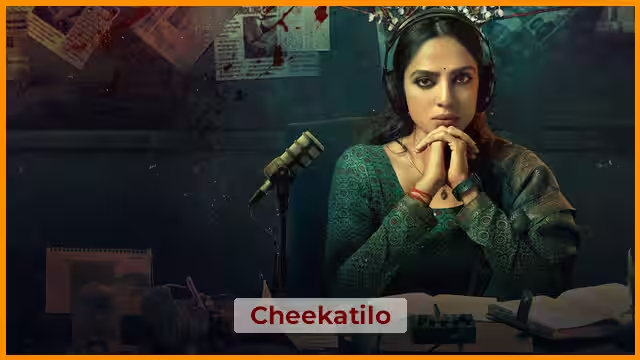
Cheekatilo (2026) lands squarely in the gritty terrain of Telugu crime thrillers, but it refuses to settle for cheap jump‑scares. The narrative follows Sandhya Nelluri (Sobhita Dhulipala), a seasoned crime journalist who grows disenchanted with the sensationalist, TRP‑hungry newsrooms that dominate Indian television. After a bitter editorial showdown, she walks away from her high‑profile TV gig and launches a true‑crime podcast—also titled Cheekatilo—with the aim of delivering stories that matter, not merely entertain.
The catalyst for the film’s central mystery arrives in the form of a brutal double homicide in Sandhya’s own apartment: her intern and confidante, Bobby, and Bobby’s boyfriend are discovered murdered, Bobby’s throat slit after a harrowing rape. The crime is not an isolated incident; it is the latest echo of a pattern stretching back decades, each scene marked by the unsettling juxtaposition of jasmine garlands (gajra) beside female victims and ankle bells (ghungroo) near male victims. These symbols suggest a ritualistic serial killer who toys with gendered motifs, turning the city’s underbelly into a macabre tableau.
Sandhya’s investigation becomes a personal crusade. Haunted by a childhood trauma that left her with a lingering sense of guilt, she channels her pain into relentless inquiry. Her podcast becomes a conduit for survivors’ voices, a platform that forces the community and institutions to confront a culture of victim‑blaming and patriarchal silence. The stakes rise as she uncovers a link to the Godavari district, narrowing the suspect pool to a powerful politician—only to discover that the true perpetrator is far closer to home: Rao, the man destined to become her father‑in‑law.
The film’s thematic core revolves around silenced voices, the commodification of trauma, and the institutional apathy that protects the privileged. By embedding the investigation within a podcast, Cheekatilo cleverly mirrors the contemporary media landscape, where truth is often filtered through algorithms and ad‑driven platforms. The tension is not merely about catching a killer; it is about reclaiming narrative agency for victims who have been systematically erased.
2. Cast & Crew Table
| Role | Name |
|---|---|
| Director | Sharan Koppisetty |
| Writer | Chandra Pemmaraju |
| Producer | D. Suresh Babu |
| Production House | Suresh Productions |
| Lead Actress (Sandhya) | Sobhita Dhulipala |
| Supporting Actor (Rao) | Vishwadev Rachakonda |
| Supporting Actor (Bobby) | Chaitanya Krishna |
| Actress (Isha) | Isha Chawla |
| Actress (Aamani) | Aamani |
| Actress (Jhansi) | Jhansi |
| Cinematographer | Mallikarjun |
| Music & Background Score | Sricharan Pakala |
| Editor (Pacing) | (Not disclosed) |
3. Technical Aspects
Cinematography (Mallikarjun) – The visual language of Cheekatilo is built on a low‑key palette that mirrors Sandhya’s internal darkness. Mallikarjun leans heavily on chiaroscuro lighting, allowing shadows to swallow city alleys and cramped interiors alike. The use of handheld cameras during the podcast recording sessions injects a documentary‑feel, making the audience feel like they are sitting beside Sandhya as she pieces together clues. In contrast, the flashback sequences are bathed in muted, washed‑out tones, subtly indicating the hazy nature of memory and trauma.
Music & BGM (Sricharan Pakala) – Pakala’s score is a study in restraint. Sparse piano notes punctuate moments of revelation, while low‑frequency drones rise during the murder investigations, creating an omnipresent sense of dread. The recurring motif of a solitary violin, woven with ambient city sounds, underscores the loneliness of a woman fighting against systemic indifference. The music never overpowers the narrative; instead, it acts as an emotional undercurrent that amplifies tension without resorting to cliché thriller clichés.
Pacing & Editing – The film maintains a deliberate rhythm for most of its 126‑minute run‑time, allowing investigative details to breathe. Early episodes of Sandhya’s podcast are presented as episodic mini‑chapters, each ending with a cliff‑hanger that keeps the viewer hooked. However, the climax accelerates abruptly, compressing several plot revelations into a short burst of action. While this rapid escalation heightens adrenaline, it also sacrifices some narrative payoff, leaving certain character arcs feeling under‑explored.
4. Performances & Characters
Sobhita Dhulipala (Sandhya Nelluri) – Dhulipala delivers a performance anchored in quiet intensity. She eschews melodrama, opting for a measured delivery that conveys both professional composure and personal vulnerability. Her eyes often linger on empty spaces, hinting at the unresolved trauma that fuels her drive. The subtlety of her body language—tight shoulders when confronting authority, relaxed posture during moments of triumph—creates a layered portrait of a woman refusing to be reduced to a victim.
Vishwadev Rachakonda (Rao) – As the eventual antagonist, Rao is portrayed with an unsettling calm. Rachakonda balances charm with a chilling detachment, making his eventual reveal feel both inevitable and shocking. His interactions with Sandhya are laced with paternal affection, which later morphs into a predatory menace, adding a disturbing familial dimension to the serial killings.
Chaitanya Krishna (Bobby) – Though his screen time is limited, Bobby serves as the emotional catalyst. Krishna imbues the character with youthful optimism, making his brutal death all the more jarring. His chemistry with Sandhya feels authentic, reinforcing the stakes of her investigation.
Supporting Cast (Isha Chawla, Aamani, Jhansi) – The female supporting roles are more than narrative footnotes; they represent the varied faces of survivorship. Isha Chawla’s survivor delivers a poignant monologue that crystallizes the film’s commentary on patriarchal suppression. Aamani and Jhansi provide nuanced portrayals of women navigating a world that routinely discounts their testimonies, adding depth to the social critique.
5. Box Office & Collection
Cheekatilo bypassed a theatrical release, debuting directly on Amazon Prime Video on 23 January 2026 as a Prime Original. Consequently, traditional box‑office numbers are unavailable. However, Amazon reported that the film entered the platform’s “Top 10 Global Originals” within 48 hours, amassing over 15 million streams in its first week. Industry analysts estimate that the streaming rights deal with Amazon fetched a figure comparable to a mid‑range Telugu theatrical release, ensuring that Suresh Productions recouped its production budget (rumoured to be around ₹12 crore) within the first month.
6. What Works & What Doesn’t
Pros
- Sobhita Dhulipala’s nuanced lead performance – anchors the film with credibility.
- Innovative use of a true‑crime podcast as a narrative device, reflecting modern media consumption.
- Mallikarjun’s atmospheric cinematography – the darkness feels palpable and purposeful.
- Social commentary on patriarchy and victim‑blaming – handled with sensitivity rather than preachiness.
- Sricharan Pakala’s restrained score – amplifies tension without overwhelming the story.
Cons
- Rushed climax – the final act condenses several revelations, leaving some plot threads dangling.
- Limited development of secondary characters – a few supporting roles could have benefited from deeper backstories.
- Pacing unevenness – the middle third lingers on procedural details, risking viewer fatigue.
- Absence of a credited editor – makes it difficult to assess the film’s editorial choices.
7. My Rating & Final Verdict
Rating: 4 / 5
Cheekatilo is a commendable addition to the growing roster of Indian thrillers that aim for more than just surface‑level scares. Its strength lies in a protagonist who refuses to be a passive victim, a story structure that mirrors the investigative nature of modern podcasts, and a visual‑aural design that immerses the viewer in a world where darkness is both literal and metaphorical. While the hurried climax and occasional under‑utilized supporting characters prevent it from reaching perfection, the film’s ambition and execution merit strong recommendation—especially for audiences seeking a thriller that interrogates societal wounds as much as it thrills.
Bottom line: Stream Cheekatilo on Prime if you’re ready for a suspenseful, socially aware ride that keeps you thinking long after the final episode ends.